
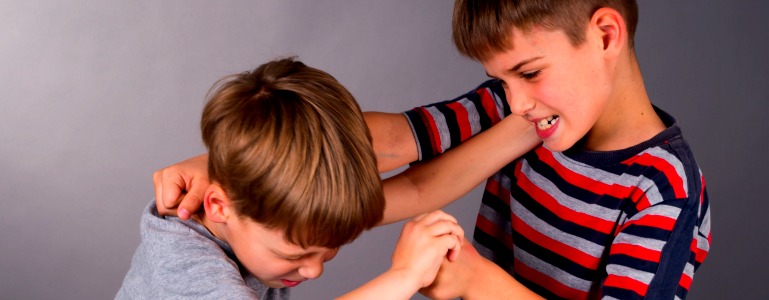
You’re sitting relaxing for a few precious minutes before getting ready to make dinner, and you hear yelling echoing from the back of the house. You tear back there to find your child in what looks like a brawl with a sibling. Once separated, you proceed to yell back in order to make clear your disapproval. Sound familiar?
Parents, teachers, and after-school staff often assume that aggression in children is always a direct response to anger. This may be true some of the time—but not always. And your response doesn’t always need to match their intensity to make a point. There are other, more effective ways to understand and deal with an aggressive child.
Why Children Become Aggressive
One of the first things to remind ourselves is that aggression is innate in all of us. Biologists, anthropologists, and psychologists agree on this. Child psychologists will tell you that play is a child’s way of communicating their experience of the world—and that includes aggressive play like wrestling or play-fighting. This is normal, especially in early childhood, as children learn to navigate boundaries, frustration, and social dynamics.
But sometimes aggressive behavior goes beyond developmentally typical rough-and-tumble play. It can be a sign of anxiety, overwhelm, or difficulty regulating emotions. Aggression that is based on a physiological response to a perceived threat in the environment can easily be misread as pure anger—when in fact, the child is scared, overstimulated, or feeling out of control.
It is always important to sit with your child following an outburst of any kind to help them calm down. Waiting until they are calm is a critical step in helping them articulate their experience. If their brain and body are still in overload, they will not be able to use their mind to explain what happened or apologize with true remorse.
When to Be Concerned About Aggressive Behavior
If you believe your child’s aggressive behavior falls outside the bounds of normal developmental tasks and is not a reaction to a temporary stressor, ask yourself these questions:
- Are they causing harm intentionally?
- Are they hurting animals or smaller children?
- Are they destroying property?
- Is the aggression happening frequently and across multiple settings (home, school, with friends)?
- Does the behavior seem out of proportion to the trigger?
If you answered yes to several of these questions, it may be time to seek additional support. Persistent aggression can be a sign of underlying anxiety, depression, sensory processing challenges, or other issues that respond well to early intervention. You may also find it helpful to read more about supporting children through difficult times and the social-emotional skills that help kids self-regulate.
How to Respond to Aggressive Behavior at Home
Here are strategies that child psychologists recommend for parents dealing with aggression:
- Stay calm. When you match your child’s intensity, it escalates the situation. Take a breath and lower your voice.
- Set clear, consistent limits. Children need to know that aggression is not acceptable—and that there are predictable consequences when it happens.
- Name what you see. “It looks like you’re really frustrated right now.” Labeling the emotion helps children start to make sense of their own inner experience.
- Wait before discussing. Once the moment has passed and everyone is calm, talk about what happened—what triggered it, how it could be handled differently next time.
- Look for patterns. Does the aggressive behavior happen at a certain time of day, or around specific people or situations? Patterns can point to underlying stressors.
- Praise calm behavior. Catch your child handling frustration well and name it. Positive reinforcement is powerful.
Talk With a Specialist
The Center for Children and Youth can help assess whether your child is on track developmentally, struggling with anxiety or depression as a source of aggressive behavior, or managing other issues that feel out of their control. Our licensed clinicians work with children and families to build practical, lasting strategies for managing difficult behavior.
Schedule a free consultation with our team to discuss your child’s specific needs.
Beth Berkowitz, Psy.D. is a Licensed Clinical Psychologist and Director of Children’s Clinical Services and Child Training Institute at the Center for Children and Youth.